

Client Vs. Agency: The great divide

Updated: Oct 7, 2020
(This is a transcription of my talk for the East Midlands Business Marketing Club 5th July 2018.)

Hi everybody, great to see you all here tonight. So this is the topic for the night and I was asked to try and give you a perspective from both sides of the fence. So I thought I'd better start off by telling you who the hell I am.

My name is David Coghlan, I’m currently Head of Marketing for OpenWrks. We are a VC backed Fintech based in Nottingham. I’m also a music fan, A squash player and cat enthusiast.
The relevance or otherwise of this information will become clear through this story.

So how did I get here?
I started off by doing a degree in Communications - Which to the great delight of my housemates at the time was called a 'phony degree' by The Simpsons.
I did it basically because, at 18 years old, I had no idea what I wanted to do and it sounded interesting. I spent three years doing a bunch of media stuff from writing, photography, TV production and Radio presenting and producing.
Given my enthusiasm for music, I came out of Uni knowing I wanted to go into Radio.

I moved from Wales to Ipswich after graduating. Because obviously that's where all successful radio presenters and DJs go...
I did some presenting and producing for a local community radio, DJ'd in bars and clubs and worked in a record shop which was basically exactly like the film Hi Fidelity.
So while I was trying to get my career in music going, this was actually my first exposure to eCommerce and selling online. I’d actually bought records from this very shop online while I was in Uni. Which in 2002 was pretty cutting edge.
Unsurprisingly my path to superstar DJ didn’t work out so with no clear career path really panning out I moved to Nottingham with my then-girlfriend. With the simple rationale that, "It’s a city there’s bound to be something to do there..."

As you saw, I’m a squash player, so when I moved to Nottingham I joined Nottingham Squash Club, and it was while I was lying on the floor after a particularly vigorous game I noticed a job advert for assistant manager, I thought “I can do that” and I managed to convince the club that I could.
My job description was pretty simple:
"Raise awareness of the club and get new members to join.
But also they had no budget, no people and no idea what I should do.

So I ended up looking at digital marketing basically because it was free.
This was 2006/07 so Google was a thing, the first iPhone was being launched and we all had MySpace accounts. I spent my evenings and weekends learning basic HTML so I could update our website, teaching myself photoshop so I could create promo graphics and writing emails to get people who walked in, to think about coming back and giving us some money.
All basic stuff, but I loved it and it had a real impact on the business. I decided this was what I wanted to do.
So now I knew I wanted to work in Marketing I put myself through a CIM course on Tuesday evenings at Derby Uni so I had some formal marketing qualification and then started putting what I learned to the test at the squash club.

I spent a couple of years slogging away at this and was pretty keen to get a ‘proper’ marketing job. (Experian kept rejecting me…)
But it was after a board meeting where I had presented a BCG matrix of our product portfolio of utter dogs that the FD took me to one side and said;
"Nobody has ever presented a BCG matrix to this board, nobody had a clue what you were talking about but I think you’re doing a good job."
he was looking to launch a new business consulting and business growth agency and asked me to join him to look after the marketing side and become an equity partner in that business.
So I quit my job, became self-employed and went for it.

Shaun my business partner and now long term friend and mentor is one of the smartest people I’ve ever met.
His vision for the business was epic, and as a PwC chartered accountant he’d done the sums and nailed the business plan on paper.
We now had to execute like hell to make it a reality.
For me the learning curve went vertical - Not only did I now need to learn, talk with authority and deliver full mix digital marketing activity for clients but I had a business to run and my personal finances were at risk.
Believe me, nothing focusses the mind quite like personal risk.
So I doubled down on learning SEO, Paid Search, marketing automation both for our clients and our own business and I project managed website builds.
It was a frenzy and a rollercoaster-like I’ve never experienced before or since.

So what happened? Why am I talking to you tonight as a client-side marketer and not a successful agency owner?

After bootstrapping for 18 months, we landed our first client on a big retainer. This was the objective all along.
We thought we’d made it. We could finally get our heads up and finally be less hand to mouth.
Our client was a manufacturing business and they were very overexposed to Ford >50% of their business with that one customer, if Ford pulled the plug on that contract the entire business was at risk.
Shaun spent a bunch of time helping them identify areas to remove unnecessary cost while I was working on how we could find other clients to de-risk their income.
All logical stuff right. But of course, this client was WAY over 50% of our business…
Guess what happened?

Of course, Ford pulled the plug and the client executed our advice perfectly, removing every unnecessary cost they didn’t absolutely need.
Including us.

By now my personal finances were on the rack so I needed a job.
I tried my luck with Experian (again) and this time was lucky enough to be hired. This was another chance to do something I hadn’t done before and earn my corporate wings.
In 2012 I was lucky enough to join Experian at a time when digital was essentially the poor relation of the businesses poorest relation, marketing. However, there was a big focus on digital during my time there and as a marketing function we did some good stuff that laid the groundwork for where the business is moving towards now.
The SME business that I used to work in in particular has seen a huge switch in terms of its business model from a massive outbound led sales machine to a more digitally led inbound business.
It might sound obvious today in terms of the cost to acquire and serve customers online, but turning an oil tanker like Experian, even a small part of it, is no mean feat and the good work there continues.
I did alright as well, won a coffee machine and was awarded B2B Marketer of the year in 2015.

After three years with experian learning how to manage stakeholders I got head-hunted to join OpenWrks as their head of marketing.
Today we’re doing a bunch of really exciting stuff with Open Banking and are right at the forefront of that technological wave that will hopefully start making all of our financial lives a lot easier.
And now i’m here talking to you folk…

So what does this frankly self-indulgent whistle-stop tour of my career to date mean? Because after all, we're all just marketers in this room right?

Well yes...

But no.

We are all individuals.
My marketing 'career' is not a career. It's me just bumbling around doing stuff to earn some money and trying to do things I enjoy and am alright at.
And of course, I'm not alone. I constantly hear stories from marketers who also have rambling careers that somehow end up in this industry. We are a disparate bunch with innumerable paths into marketing and as a result of that we all have very different and specific experience and skills as a result.
As we all know, segmentation is just a means of grouping people who match a similar set of characteristics together. But it’s never perfect or accounts for the nuance.
Their is infinite nuance in both the client-side segment and the agency side segment, but the most binary separation between these two groups is the fundamentally different business models at play.

Experts cost money and that money is tough to justify for businesses, particularly in the B2B space, where there is potentially less direct RoI and a wider variety of 'stuff' that needs to be done.
Businesses could try to leverage internal expertise across multiple areas or Business Units, but that’s a real challenge for big organisations.
Who has ever worked with or in a central marketing function? How did that go? Also, what was the business appetite for hiring account directors or project managers to join the dots and make sure stuff gets delivered and adds value?
To be valuable, experts need to be given work that they can do better than anyone else.
That can only come by operating across multiple businesses.

Accept this fact.
Breadth of expertise is what can help drive a 2% lift in global EBIT. A team of highly paid specialists utilised a fraction of their time won't. And your FD or CFO will hate the cost.
But as client-side marketers, we need to know this, accept it and also tell our agencies that we realise this fact.
Then pay them for their knowledge.

At the highest possible level, when it comes to a client /agency engagement, client-side marketers are just trying to get stuff done that they are can't do themselves. (But that they want to take credit for)
They are asking:
What are my business objectives?
What are my limitations to reaching that objective? (budget, tech, resource, knowledge, etc.)
How do I overcome these limitations?
While Agency side marketers are trying to make sure they balance keeping their teams fed with the right work without taking on projects that could cripple them.
Can we deliver what the client is asking?
Can we deliver profitably? (knowledge, capacity, value etc.)
But we’re all individuals, so we're all thinking what's in it for me?
Will this agency make me look good?
Is this a good client for my agency?
What if I don’t meet my objectives?
Will the agency be thrown under the bus if it doesn’t work?

So what's it like having worked on both sides of the line?

This got me thinking about my time on both sides of the camp and what annoyed me.
Time thieves: Clients who pay literally nothing (<£200 pm) but expect the earth
Scope creep: Lack of definition and/or understanding of what they need and even when that clarity is agreed, goalposts move after the event but there's an expectation that costs won’t move
Unrealistic timelines: Of project delivery and of business impact
Client-side execution: “This is Bob. He does our book-keeping 2 days a week but he also looks after our marketing”
Getting paid: We did the work 3 months ago, when do I get my £300?

Meanwhile on the client-side, a different set of frustrations.
Communication/resolution speed: "This is important to me, I need it to be important to you."
Not responding to brief: "I’ve asked for brand strategy, why are you selling me design?"
Unnecessary/inflated costs: Zero’s being added to bills because you work for a larger brand or contingency being pre-emptively added into costs. 'Project management'
Service delivery: Late/delayed delivery, Lack of impact, Lack of focus

We've talked about the fact that businesses can't afford expensive expertise on their payroll. It means Agencies have that expensive resource that they need to keep fed with clients.
This is great for client-side marketers as it offers us not just detailed expertise but also breadth of experience from across industries and clients that they can then bring to bear on our business.
Which makes us look awesome!

So how do we reach across this divide to all succeed?
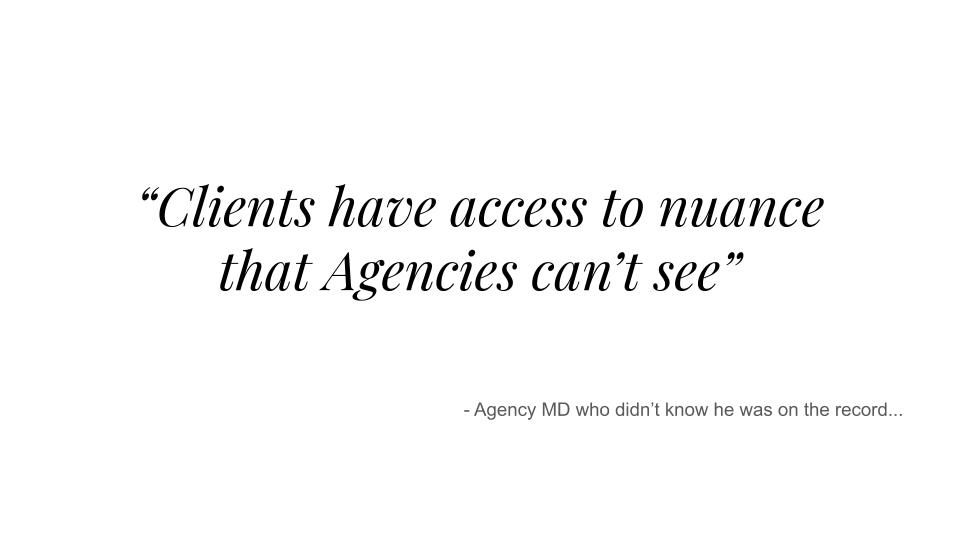
Agencies might have greater channel expertise but they don’t know your business.
As a client-side marketer, you are the only one who knows your business objectives and how your role as a marketer fits into those objectives. It is your job to educate your agency about your challenges, your current rationale about how you will meet those objectives and most importantly where you need help and how you expect that help to be delivered.
Requirement definition is THE critical part of any successful client/agency relationship and in my opinion the most important part of a client-side marketers' job.

Insight from Dr. Dave Chaffey and the 2018 IDM skills survey agrees.
The key takeaways/skills for marketers are:
Strategy
project management
Basically bringing stuff together.

So am I eating my own dog food now?
I still have an SME mindset. I.e. I’m tight with money, so I write briefs.
What is the problem?
Can we fix it well and quickly internally?
If you can’t clearly articulate what you need, how will an agency be able to give you what you want? Time invested upfront here is always valuable.
Client-side hack; A well written brief helps you manage internal stakeholders. You can give visibility of the brief i.e. what you are going to ask for, before you even speak to an agency.
To prevent the spectre of scope creep, a brief also holds you to account, when the agency delivers for you they have a document which says ‘This is what you asked for’ so you need to make sure you get everything in the brief you actually want/need.
A good brief avoids confusion on both sides and errors during a project/campaign as a result of assumption or interpretation from either side.
A good brief reduces time and cost.
Most importantly it helps YOU understand precisely what sort of an agency engagement you are looking for.
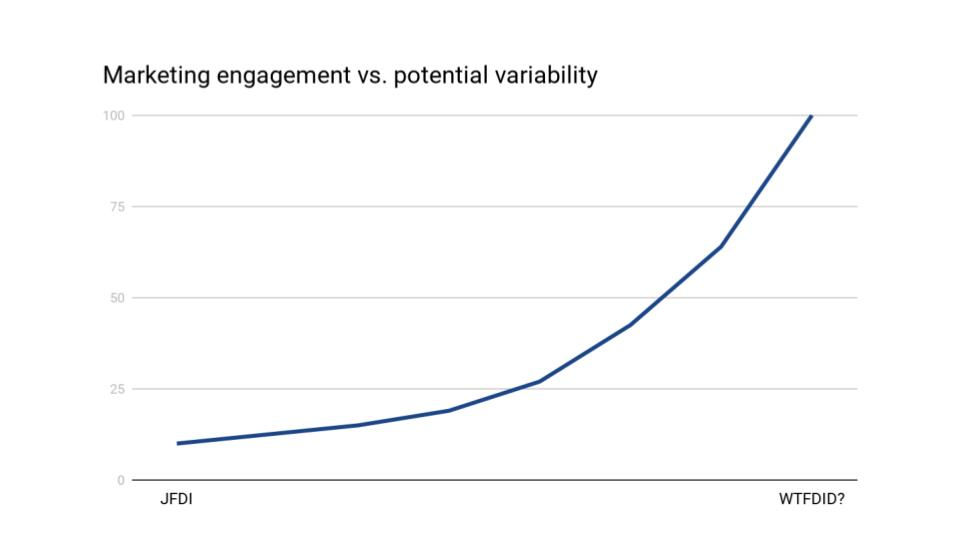
I always consider an engagement on this continuum. On the bottom left you have a very directive brief 'Just flipping do it' on the other end 'What do I do?'
The tighter the brief and the more detail you can provide the less the likelihood of variability in the project delivery. either in time, cost, or scope. The more unknown's there are, obviously the greater the chance for variability.
This is not necessarily a bad thing. But knowing upfront both internally and with your agency that you’re on a journey together will help both parties know what the future work might look like.
Knowing up front where on the ‘doing’ or ‘thinking’ axis your project is definitely going to be helpful for all involved.

At this stage, both parties should challenge hard. It’s easier to set expectations and challenge on deliveries when no work has been done.
Challenge should be done both ways. Client-side marketers should push agencies that want to please as well as ones that want to delay. Uncovering why a partner is so keen to accelerate or delay helps set the scene for the potential relationship.
Agencies should challenge client-side marketers to provide clarity of both the request and the purpose of that request. Again thrashing this out ahead of time, might feel slightly uncomfortable, but it really creates alignment early on.
And from this, you can mutually agree on what is realistic in terms of timelines, budget and impact.

It also flushes out the status of the potential relationship.
Tactical projects for a client could be major strategic initiatives for an agency and vice versa. Ensuring alignment here upfront is vital.
Don’t take the piss with free support. Be frank and honest with agencies about your expectations and how important this project is to you and even more importantly, to your business.
Agencies can often be left holding the baby if a client-side marketer leaves the business with a mess that the agency has to tidy up for free. The agency also loses its link to a business if their client lead leaves.
We have a duty of care to the people who have helped us succeed and even how you manage your internal stakeholders has a direct impact on an agency's ongoing relationship with that business.
So try not to be a dick.

So in summary, both client-side and agency-side marketers all have unique and broad skill sets.
Agencies have the expensive channel experts so pay them for that expertise and bring your business side expertise to align the project for everyone.
Write clear briefs. Know what you want and where it sits on the doing / thinking axis. Challenge hard upfront before any work is done and any money is spent.
Don't be a dick. Especially if you've taken the glory of success that your agency has helped you deliver.
Cheers


Comments